
Jewish doctors in the Warsaw Ghetto secretly documented the effects of Nazi-imposed starvation, and the knowledge is helping researchers today – podcast
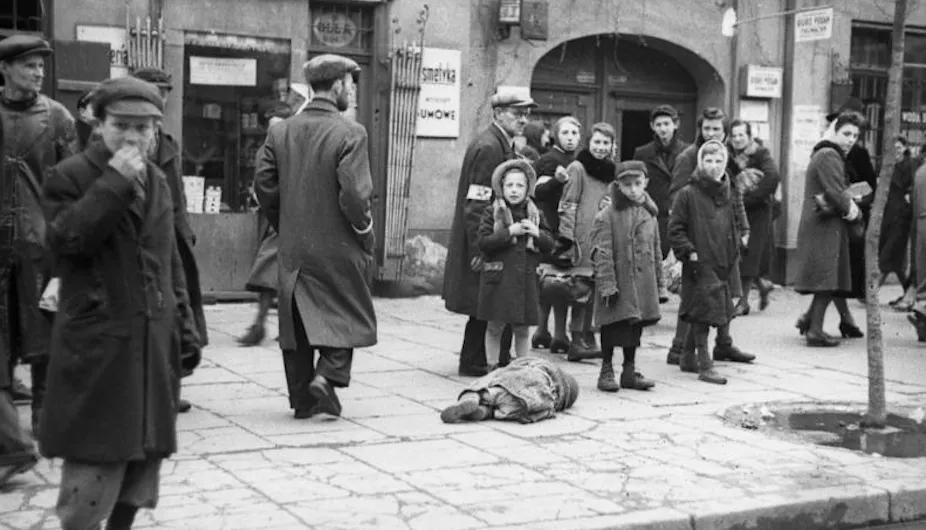
A small child lying on the sidewalk, presumably from starvation.
Starvation was omnipresent in the Warsaw Ghetto for both young and old. Blid Bundesarchiv/Wikimedia Commons, CC BY-SA

During the years of suffering and tragedy that defined the Warsaw Ghetto in the midst of World War II, a team of Jewish doctors secretly documented the effects of starvation on the human body when the Nazis severely limited the amount of food available in the Jewish ghetto. The doctors collected this work in a book and, 80 years later, Merry Fitzpatrick rediscovered the brave efforts of these doctors hidden in a library at Tufts University, in Massachusetts in the U.S. In this Discovery episode of The Conversation Weekly, we speak to Fitzpatrick about how she found this piece of history, the story of its creation and how modern scientists are learning from the knowledge so bravely documented by the Jewish doctors.

Merry Fitzpatrick is an assistant professor at Tufts University who studies food security and malnutrition, especially in conflict zones. One day, she was searching through the school library and came across a book that she had never heard of in the basement.

“I went and pulled it off the shelf, and it was this crumbling little book. Its pages were just brown and brittle, and you could tell it hadn’t been opened in a long time,” she says. The foreword described the conditions of the Warsaw Ghetto and the anguish of doing research there. It was written by Israel Milejkowski, who Fitzpatrick calls the “Fauci of the ghetto”, after the former chief medical advisor to the U.S. president Anthony Fauci.

Children climbing a wall.
Smuggling was how most people in the ghetto got food, and children were often the ones sneaking out of the ghetto to do it. nieznany/unknown via Wikimedia Commons

Over the course of 1941 and 1942, Milejkowski and his colleagues saw an opportunity to produce something good from the horrors of the Nazi-controlled ghetto. The lack of food was extreme. “The Jews were given a ration of 180 calories a day at one point. That’s like half a cookie,” says Fitzpatrick. As the doctors took care of the Jewish population in the ghetto – including their friends and colleagues – they documented the effects of starvation, too. These doctors then collected their research into the book that Fitzpatrick found.

Even today, the research done by the Jewish doctors is shedding light on some mysteries within the field of starvation and malnutrition research. Tuberculosis was very common in the ghetto, but when the doctors would test starving children with obvious symptoms of tuberculosis, the tests would often come back negative. As Fitzpatrick explains, “What it was was that in starvation, the body pretty much gives up on immunity – that’s not the priority. So when you do a test, you’re looking for an immune response that isn’t there.”

To find out how this idea is helping Fitzpatrick better understand HIV in malnourished children and the rest of Milejkowski’s story, tune in to this week’s episode of The Conversation Weekly.


This episode was produced by Mend Mariwany and hosted by Dan Merino. The executive producer is Mend Mariwany. Eloise Stevens does our sound design, and our theme music is by Neeta Sarl.

You can find the original story written by Merry Fitzpatrick and her colleague Irwin Rosenberg on The Conversation.

You can find us on Twitter @TC_Audio, on Instagram at theconversationdotcom or via email. You can also sign up to The Conversation’s free daily email here. A transcript of this episode will be available soon.

Listen to “The Conversation Weekly” via any of the apps listed above, download it directly via our RSS feed or find out how else to listen here.


you can click here to watch the video

Comments

Popular posts from this blog

Terrified Daily life in the Warsaw Ghetto through rare photographs, 1941.A woman lying on the pavement in the Warsaw ghetto, starving to death, 1941

Terrified Daily life in the Warsaw Ghetto through rare photographs, 1941.A woman lying on the pavement in the Warsaw ghetto, starving to death, 1941 On 2 October 1940, Ludwig Fischer, Governor of the Warsaw District in the occupied General Government of Poland, signed the order to officially create a Jewish district (ghetto) in Warsaw. It was to become the largest ghetto in Nazi-occupied Europe. All Jewish people in Warsaw had to relocate to the area of the ghetto by 15 November 1940. The ghetto was sealed on that date. In total 113,000 gentile Poles were forced to resettle to the ‘Aryan side’ and were replaced by 138,000 Jews from other districts of the capital. The ghetto reached its highest number of inhabitants in April 1941. Within its wall lived 395,000 Varsovians (residents of Warsaw) of Jewish descent, 50,000 people resettled from the western part of the Warsaw district, 3,000 from its eastern part as well as 4,000 Jews from Germany (all resettled in the early months of 1941). ...

8 Things Women Used to Be Banned From Doing

Topical Press Agency/Getty Images / Topical Press Agency/Getty Images Despite the major strides made in gender equality in recent decades, there’s plenty of evidence that women stand to benefit from a  proposed  Equal Rights Amendment to the Constitution that guarantees rights and wages proportionate to males. Currently, women are paid less than men in almost every field, regardless of education or even unionization—but that facts pales in comparison to some of the more outrageous prohibitions and laws that were once proudly discriminatory. While not having the  right to vote  was bad, some of these gender-suppressing policies were worse. Here are a few things that, at one time or another, women couldn't do. 1. GET A CREDIT CARD While lopsided income continues to be a problem in the workforce, there was a time when banks wanted to dictate how women spent what money they did earn. In the 1970s, single or divorced females applying for a credit card were often...

Popular posts from this blog

How common were instances of sexual abuse in Nazi concentration camps

How common were instances of sexual abuse in Nazi concentration camps. The accounts that rap£ or prostitution was common, Were the guards were given "free reign" over the prisoners given view of them as subhuman The Nazis sort of developed a network of state-controlled brothels during the war. This included both the civilian and military brothels. The Nazis even set up brothels for the forced labor inmates that helped with the German war effort as incentives for higher production from prisoners in camps. Back then these brothels were suppose to serving several needs. For the soldiers that were far away from home, the Nazis thought that having these brothels would reduce the possibility of rape in occupied lands and reducing the sexual relations with impure local women or forced laborer's, as well. Heck, the Nazis tried to use these brothel women to cure homosexuality as a treatment with male prisoners that were gay. Regular German women were exempt from serving in these b...

The prisoners in concentration camps have sex with each other

 The prisoners in concentration camps have sex with each other Steady on. Nearly all concentration camps were single-sex, and at those that held both men and women the sexes were usually kept separate, though at Auschwitz III (Monowitz) and possibly also some other sub-camps they worked together. At extermination camps (where the sexes were not separated) most of the prisoners were killed within 24 hours of arrival. Prisoners did not have privacy. Remember that at the time most people had a horror of same-sex relations, especially between men. However, some Kapos and even guards forced prisoners to have sex with them. In Night Elie Wiesel relates how he found his Kapo having sex with a female prisoner, and he (Wiesel) was given 25 lashes for finding them having sex.* In the Women’s Camp at least one guard forced another woman to have sex with her, and at many camps there was a piepel (camp bum boy). *He also describes the hanging of the piepel of a Blockältester ( ‘block senior’). ...