
Lucy McRae creates cushion machine to offer lab-grown humans a womb experience

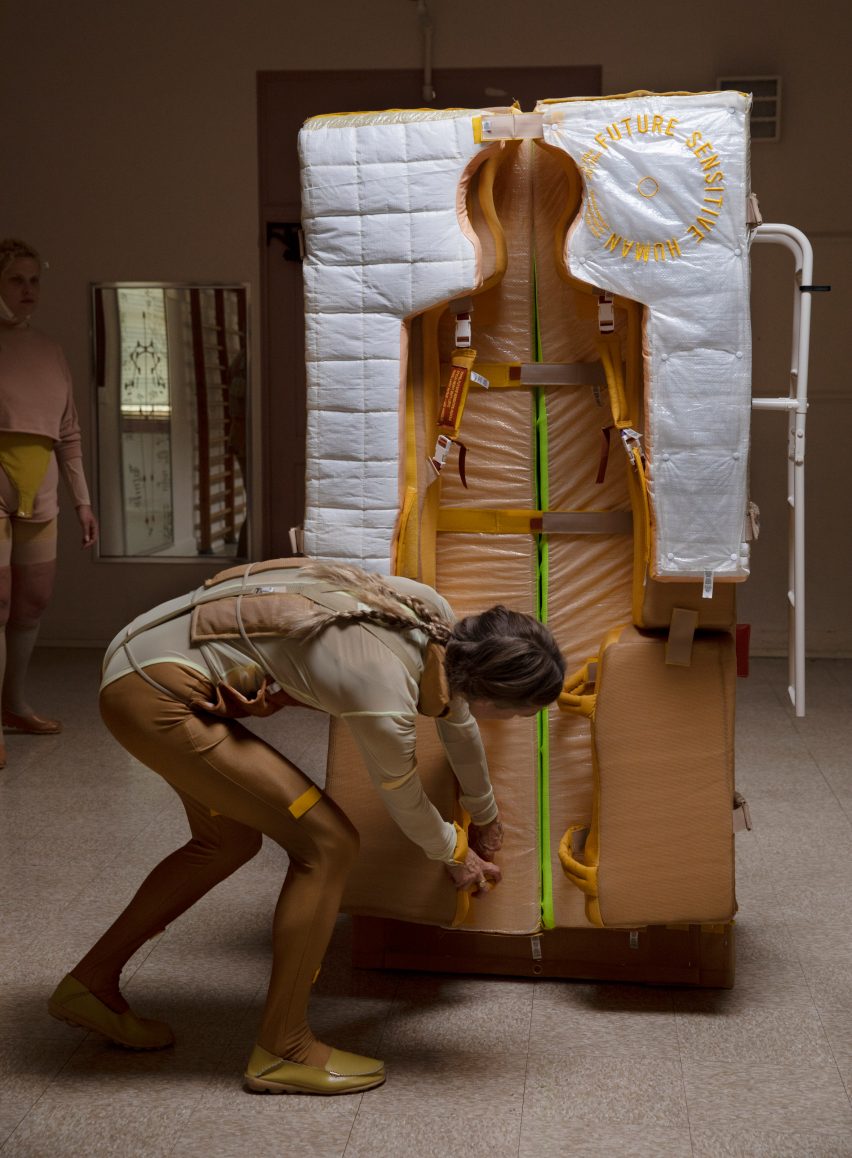
Future humans grown in artificial wombs could replace the embrace of a parent with Heavy Duty Love, a machine created by sci-fi designer Lucy McRae for the Venice Architecture Biennale 2021.

The cushioned machine completely surrounds its occupant in a supportive embrace, helping them to become more comfortable with contact and intimacy.
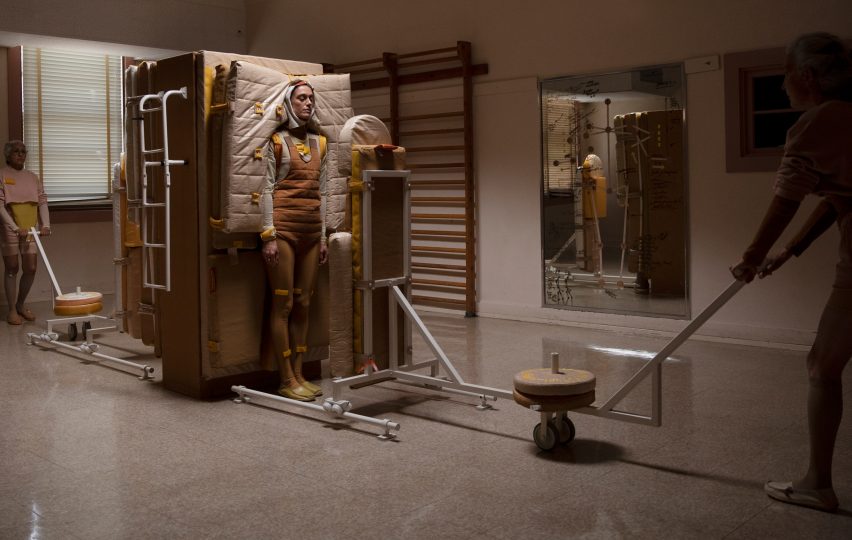
Heavy Duty Love by Lucy McRae
The machine surrounds the user with cushions

Los Angeles-based McRae imagines it could compensate for a lack of human contact in early life, which could become a reality in the near future. Scientists believe that artificial wombs will be developed within the next decade.

"I made this machine because I am curious about the human consequences of bypassing the womb and that first hug of a 'mother'," McRae explained.

"[I'm] envisioning a new generation of children having radically different formative years, developing new types of sensitivities and neurobiological quirks. Heavy Duty Love questions whether these future sensitive humans will find new ways for intimacy and togetherness."
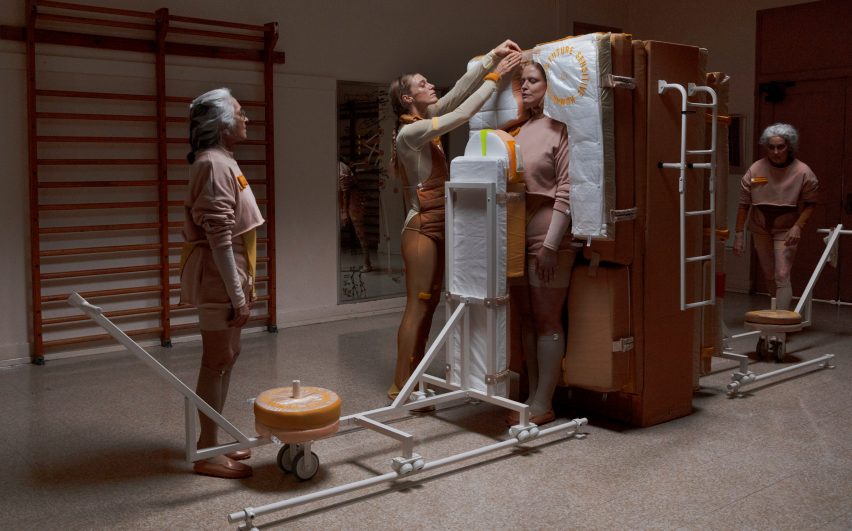
Heavy Duty Love by Lucy McRae
A sliding mechanism allows a final set of cushions to be placed in front of the user

The machine can be used by two people at a time. They stand themselves within a frame of cushions, position their legs and arms within the straps, then the machine operators slide a section of the machine to place a final layer of cushions into place in front of them.

The cushions are made from tarpaulin, carpet underlay and industrial velcro.
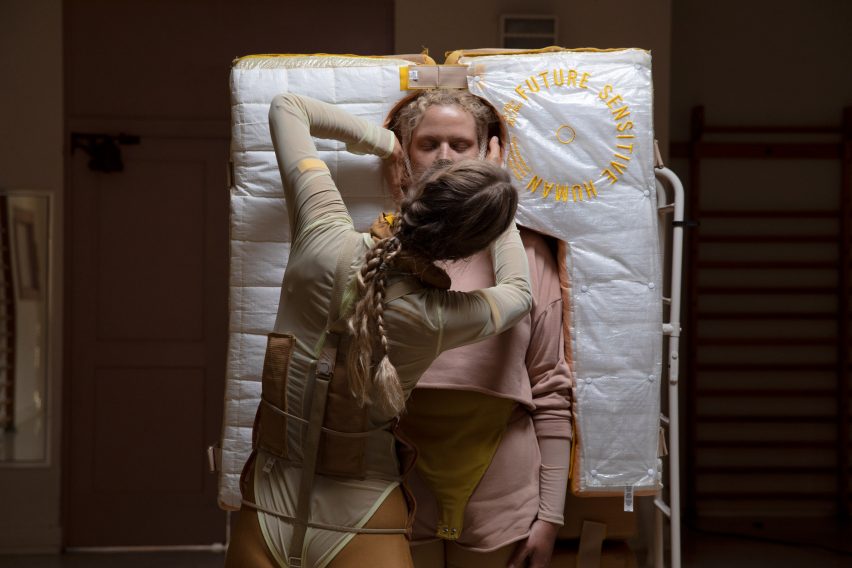
Heavy Duty Love by Lucy McRae
It is designed to surround the entire torso

The project responds directly to the biennale's theme: how will we live together? McRae believes people are at risk of losing a fundamental human connection if we move towards a future where artificial wombs become commonplace.

"Touch is said to be the first sense developed in utero – would it develop later than other senses if wombs were artificial?" she asked.

"Heavy Duty Love will act as a proxy, a comfort blanket, offering a new type of nurture for a future-sensitive human," she told Dezeen.
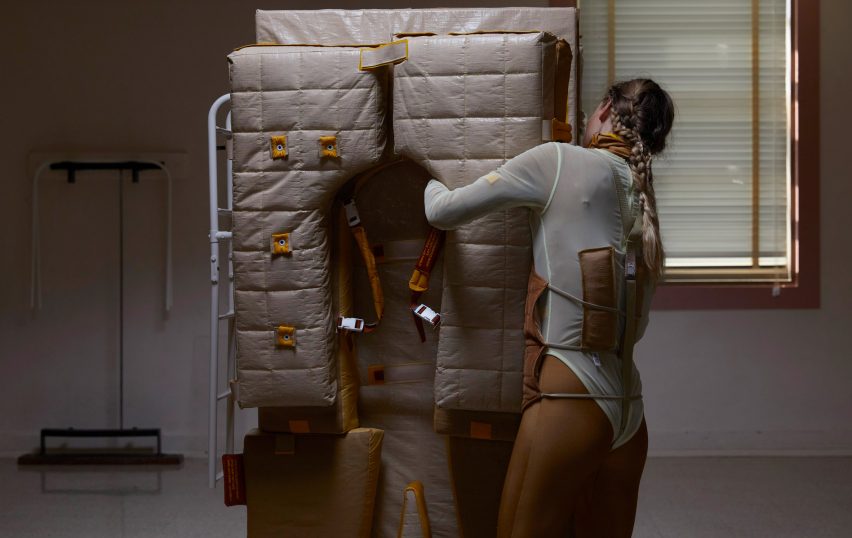
Heavy Duty Love by Lucy McRae
Adjustable straps allow for a tight fit

McRae describes herself as a "body architect". The machine is part of a series of works she has created, exploring how the human body and human condition can be engineered to adapt to changes brought on by technology.

Her Solitary Survival Raft, which she presented at Dezeen's Virtual Design Festival, is a conceptual survival raft designed to help people navigate an uncertain future, while her Compression Cradle is a machine that offers a simulated hug to a person craving intimacy.

In a previous interview with Dezeen, she said the aim behind her works is to provoke discussion about the role technology will play in our futures.

"We've been submissive to technology – it drips into our lives and we just adapt," she told Dezeen at the time. "It's important to challenge whether we really want it."
Heavy Duty Love by Lucy McRae
McRae has designed garments to accompany the machine

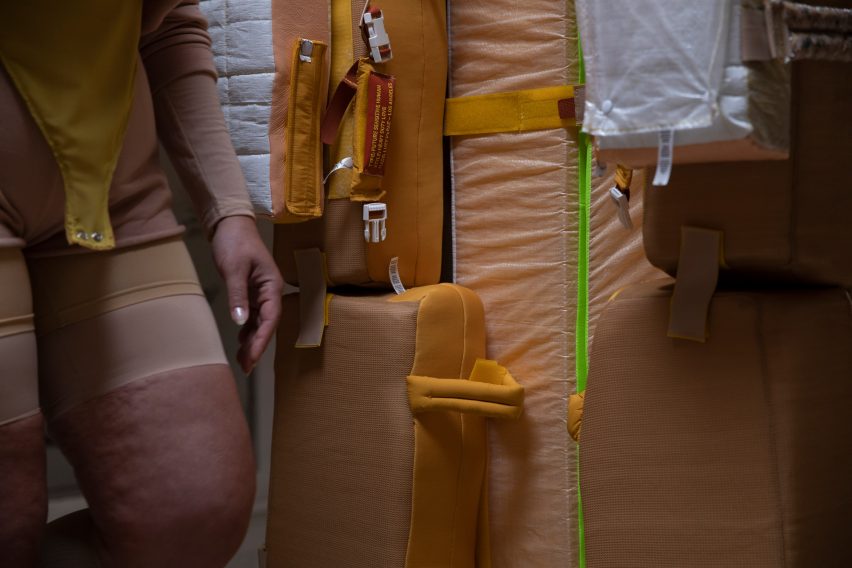
This latest project is accompanied by a range of garments with the fashion label Future Sensitive Human. The care label for the garments reads "designed for gene-edited or lab-grown babies".

Like the machine, these garments are designed to offer a form of support to their wearer. Taking cues from sportswear, sleepwear and camping gear, they incorporate straps and padding.

"The machine-wearables are mini architectures that nurture and connect the body to the device," said McRae.
Heavy Duty Love by Lucy McRae
The care label for the garments reads "designed for gene-edited or lab-grown babies"

McRae produced all the designs herself, having taught herself how to use an industrial sewing machine during the pandemic.

Heavy Duty Love is curated by Hashim Sarkis. It features in a section titled Among Diverse Beings, which explores the development of the human body, and how we interact with one another.

Also on show for the exhibition is Refuge for Resurgence, a dining table designed by Superflux to accommodate a multi-species banquet.

Heavy Duty Love will be on display in the Arsenale as part of the Venice Architecture Biennale, which takes place from 22 May to 21 November 2021. See Dezeen Events Guide for all the latest information you need to know to attend the event, as well as a list of other architecture and design events taking place around the world.

you can click here to watch the video

Comments

Popular posts from this blog

On this day, 29, Aug 2018, Handcuffed woman, 32, caught on camera frantically ringing doorbells at 3am is found SAFE - but her boyfriend, 49, has shot himself dead, sheriff reveals

On this day, 29, Aug 2018, Handcuffed woman, 32, caught on camera frantically ringing doorbells at 3am is found SAFE - but her boyfriend, 49, has shot himself dead, sheriff reveals Video: 'I never would've killed you': Shackled woman seen ringing doorbells after her boyfriend raped her reveals he left her a suicide note before shooting himself dead  watch video below Police in Montgomery, Texas, posted this disturbing surveillance footage of a barefoot woman in a t-shirt, wearing what appear to be broken shackles on her wrists, ringing a doorbell in the middle of the night.  Share this video: Video: Mysterious footage shows half-naked woman ringing doorbell The boyfriend of the handcuffed woman who was seen frantically ringing doorbells at 3am in the morning, killed himself Wednesday with a single shot to the head, cops have confirmed to DailyMail.com. But the woman — who was described as a ‘victim of family violence’ — is safe and is now being consoled by her family, Sheri...

Popular posts from this blog

How common were instances of sexual abuse in Nazi concentration camps

How common were instances of sexual abuse in Nazi concentration camps. The accounts that rap£ or prostitution was common, Were the guards were given "free reign" over the prisoners given view of them as subhuman The Nazis sort of developed a network of state-controlled brothels during the war. This included both the civilian and military brothels. The Nazis even set up brothels for the forced labor inmates that helped with the German war effort as incentives for higher production from prisoners in camps. Back then these brothels were suppose to serving several needs. For the soldiers that were far away from home, the Nazis thought that having these brothels would reduce the possibility of rape in occupied lands and reducing the sexual relations with impure local women or forced laborer's, as well. Heck, the Nazis tried to use these brothel women to cure homosexuality as a treatment with male prisoners that were gay. Regular German women were exempt from serving in these b...

The prisoners in concentration camps have sex with each other

 The prisoners in concentration camps have sex with each other Steady on. Nearly all concentration camps were single-sex, and at those that held both men and women the sexes were usually kept separate, though at Auschwitz III (Monowitz) and possibly also some other sub-camps they worked together. At extermination camps (where the sexes were not separated) most of the prisoners were killed within 24 hours of arrival. Prisoners did not have privacy. Remember that at the time most people had a horror of same-sex relations, especially between men. However, some Kapos and even guards forced prisoners to have sex with them. In Night Elie Wiesel relates how he found his Kapo having sex with a female prisoner, and he (Wiesel) was given 25 lashes for finding them having sex.* In the Women’s Camp at least one guard forced another woman to have sex with her, and at many camps there was a piepel (camp bum boy). *He also describes the hanging of the piepel of a Blockältester ( ‘block senior’). ...